If I read it right (probably not), it shows by how much at lower slew rate reaction of the motor deviates from, lags behind signal.
Cool graphs, btw, wish TD had some monitoring tool.
How do you capture all this data, including slew rate?
If I read it right (probably not), it shows by how much at lower slew rate reaction of the motor deviates from, lags behind signal.
Cool graphs, btw, wish TD had some monitoring tool.
How do you capture all this data, including slew rate?
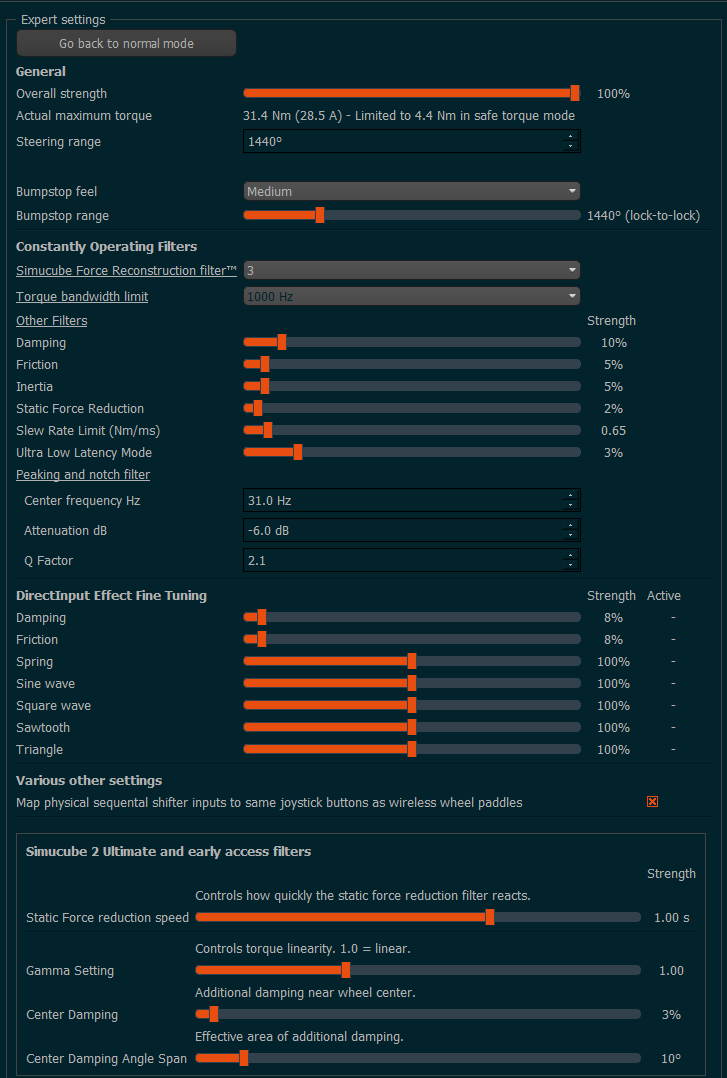
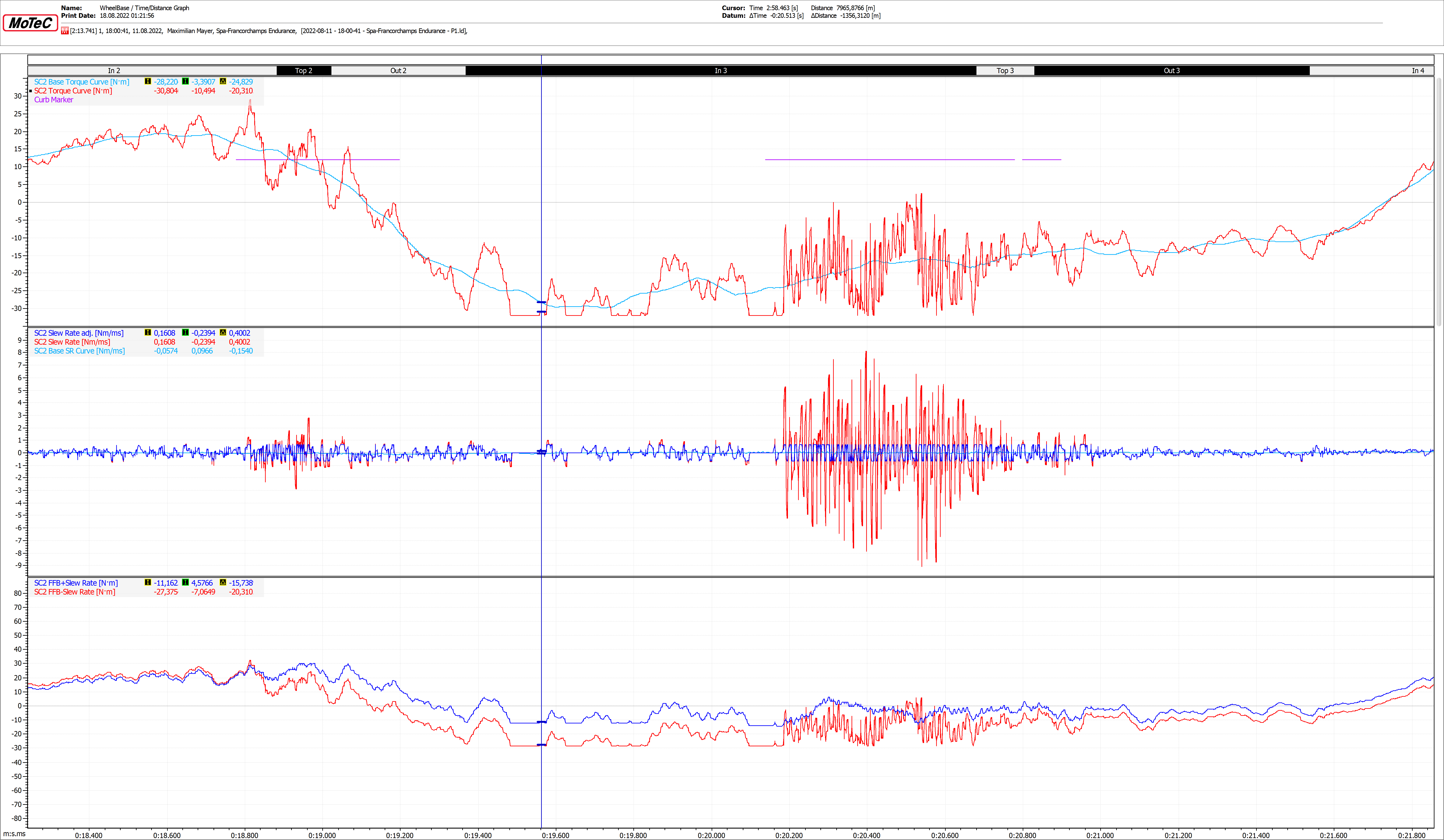
So all four screenshots show the same 3 graphs with different “Slew Rate’s” (0.1 /0.65 /2.5 & 9.5Nm/Ms).
On the first graph:
“SC2 Base Torque Curve[Nm]” shows the basic FFB-Torque…like curves for example and a bit of oversteering if it doesn’t require too much slew rate.
“SC2 Torque Curve[Nm]” shows simply the FFB signal output by (in this case) Rfactor2. So the “car multiplier”(aka PreAmp) has an influence on the curve, but also the settings in the .json files.
“Curb Marker” tells me if I’m currently driving on curbs. The reason is that I get a hind where the frequencies come from that bother me. In “La Source” you can see it quite well. (Doesn’t look like a big deaL, but it’s super practical =) Especially because the games aren’t 5-star orchestras. Hope no one will be mad at me, but anyone who has ever worked with Cubase or Wavelab knows that the CPU places limits on signal generation and SimRacing is signal generation.
The second graph just shows different slew rates.
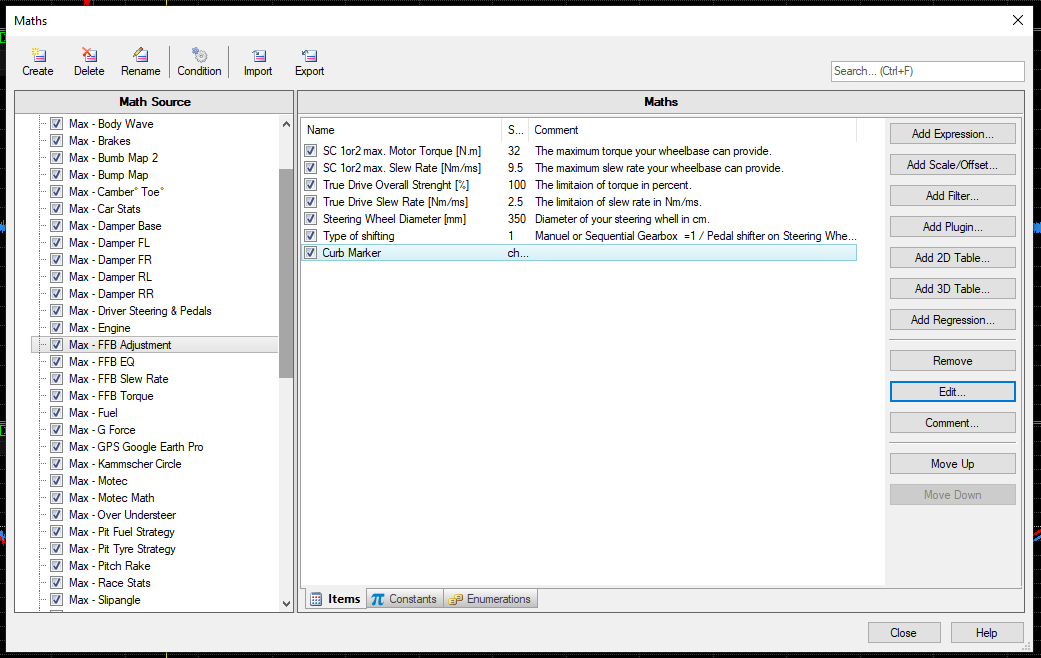
“SC2 Slew Rate adj. [Nm/ms]” shows me the slew that I would like to visualize. In other words, I recreated the “True Drive- Slew Rate -Effect” in Motec. As above (0.1/0.65…). I used to call it Adjusted (adj.).
“SC2 Slew Rate [Nm/ms]” is the slew rate the game wants, but limited by the maximum slew rate of the wheelbase. I always put the slew rates on top of each other… so you can see where the signal is being compressed. Is then the blue curve before the red curve.
“SC2 Base SR Curve[Nm/ms]” shows me the slew rate of the “SC2 Base Torque Curve [Nm]”. Namely, if you give your Simucube2 less slew rate than it needs for cornering and oversteer, you’ve definitely gone too far.
With the third graph I do the calculation back into a torque. So the red slew rate curve, which is only limited by the maximum slew rate of the SimuCube, and the blue slew rate curve, which is changed by our True Drive setting. Unfortunately, this is then distorted (NOT IN THE GAME, ONLY IN MOTEC), but you can tell by the thick curves in the flat spots. So based on the ratios and the peak to peak values. For example, with the 0.65Nm/ms slew rate I reduce the torque of the crash from ~54Nm to ~10Nm… i.e. reduced by 44Nm. So you can let children play with it with a clear conscience. 
Slew rate and static force reduction are extremely helpful imo. Slew rate limitation can make the difference when one has a huge crash at high speed. Static force reduction gives the opportunity to use more torque in general, while certain situations (fe Silverstones high speed combo Copse/Maggotts/Becketts) still can be driven at a full length race without getting too tired. Both don’t filter anything out of the amount of FFB information. Damping is adding latency, something friction does not, although you will loose fidelity/speed at the shaft with it.
Both are problem solver rather than anything else. You can use ULLM to compensate the latency you created with damping and friction.
These diagrams are interesting. To have something similar in TD is totally unnecessary. If one is interested in engineering there is sure (as we can see) plenty of 3d party software.
As a driver you don’t need to interfere with the job of engineers. Even you are good at it: no-one wants you to do such things. Be fast, win the race and let them do what is necessary for you to win.
If some already have a problem to understand what a limitation of a defined maximal value is, then TD sure doesn’t need integrated mechanical physics or telemetry implementation. This would only need a real time connection, which is exactly what brought up resistance
You definitely know more about this than I do but doesn’t lowering the slew rate make the FFB feel sort of “floaty”? That’s the best way I can describe it
Yep I see it that way too. Keep True Drive as slim as possible. It really does offer endless settings to play with.
However, you can also gain additional information with the slew rate and that’s how I use the thing. Compress the curbs and turn the torque up. Imagine totally over the top curbs superimposed on the actual FFB signal. So that you no longer feel the oversteer, but now you do thanks to the lowered slew rate. I’ve had a number of situations there… but I don’t have any right now. Recently cleaned up Motec… needed the space. 
It depends how far. That’s why I built it myself to finally get control over it.
To put it this way. I made a really nice, clear and powerfully defined FFB. I let the thing run at 32Nm and have no problems with it. It’s just great!
Very interesting comparison with Cubase! Compressing signals, how fast a curve of a signal has to rise…
In AC there is a possibility to compress lower/finer FFB signals. The result is a very detailed FFB also at low torque and while driving relatively slow. My favourite cars are open wheelers (RSS and GP). They use power steering. New cars like the the RSS 2022S or the Grand Prix 2022 coming with special physics packages. You can turn steer assist into range compression and this is very clear to see on a FFB graph. If you compare both of them, the one with range compression is much more detailed, and the feeling while driving is showing the same result.
Slew rate limitation is something I was familiar with very soon. I drive rally, and the handbrake input was just to much in too short time. The perfect solution: slew rate limitation. That is also the case when you drive with almost 200km/h through Finlands woods and you run out of talent… and this within max 10 meters: it took a blink of an eye, from 200 to be mash on a huge tree. Again, slew rate limitation is your best friend then!
@CLAYREGAZZONI
The effect is also so powerful, but I didn’t think of it right away. I had a serious accident once… a Ki pushed me away and that was it. I was allowed to take a week off from sim racing. I have an old Trace Elliot amp here and it totally reminded me of the True Drive software and when it started again, a lot of the settings just had different names. I then tried to set the Simucube2 like an old Trace Elliot GP12 smx and lo and behold it worked. It was Luck…
Something to wink at. 
The audible difference between with slew rate (compressed) and without slew rate limit (not compressed).


Add chorus, add 1250 layers, compute the best to her singing (much easier than waiting on her to meet with the beat 
 ).
).
Those games I like most are either pretty old (I wonder how a present version of AC would be like), still much to much focused on the controller customers, or a bit arcade like F1 titles.
My PC is…I don’t really know:
I7/10700
Aorus Z490AC Elite
G.Skill Trident Z.R 32/4000
Be quiet 1000 power supply
3070ti Aorus Master
Ssung 970 Evo plus nvme
250+1TB
Samsung Odyssey G9 49 curved
I think is pretty ok. Never had performance problems at 5120x1440 at 120 Hertz
I see it this way:
Someone hits me in the face. He hits with 100 kg force (let’s assume there are 100kg from the very first moment and this amount doesn’t change till it is landing in my face) and with the speed of 60 miles.
The same slap, the same speed BUT (because I told him so) with 20 kg.
Everything stays the same, only the torque per time is limited

The charm of the classics does not decrease. I can recommend RFactor2 to you. The scope is not nearly as extensive, but definitely sufficient. But the FFB is unique in the industry. They could make more vintage cars available. But they are said to have revised the physics as well. However, I cannot confirm.
At least I have a vintage machine at my feet.
AMD 2600
x470 board
32GB Ram
1070GTX GPU
Well, most of the time I’m out and about in Motec anyway. Doing experiments with it is great fun.
Here is the Eau Rouge followed by the Raidillon. The combination doesn’t have the weakest reputation.
Compressed here with 0.65 Nm/ms… you can also take a little more. But with the BMW that’s not necessary.
Make sure that it only compresses the Signal AND only the “curb”-frequencys when I drive over curbs.
Hello,
I am reassured I am not crazy, I felt that the filters gave latency.
With your settings, how do you set the FFB gain in the game? Do you leave it at 1 in Rf2 and for example 100% for ASSETTO CORSA?
The car specific multiplier is 45% for me. So for the “BMW M4 Class1”.
I don’t think you can use that for the other games. Even within rFactor2, it doesn’t fit every car and every track. =/  Sorry…
Do you or maybe someone else have a list of the available Motec channels? I’m keen on AC because of the DRM mod and the  Turbo Capri ! Whether that works as above is easy to say… It didn’t work for ACC 6 months ago.
But It definitely works for IRacing and it is almost done.
Oh I’m also a big fan of the MOD DRM especially for the Porsche 935, but I find that the FFB is not highlighted enough compared to the official KUNOS content, anyway AC is my favorite game.
Good to know… 
You feel alive when you are deep into the matter, all the precious stuff you can read and learn from it, don’t you.
I have a picture in my mind:
A screen with 20 windows, full of graphs and calculations. Everywhere cross references and notes from previous analysises…

Are these your settings for iRacing?
Sorry  , these are not intended for IRacing. I don’t think they will run well under IRacing because the FFB signal is different.
From interviews of drivers, it does seem like F1 cars are easier to drive due to all the more advanced technology in them vs other car series.
“I’ve driven Formula 1 cars. I’ve tested quite a few days with Renault. So for me, I’ll say it as it is – personally, that was the easiest car I’ve ever driven. It’s easy to drive to a certain extent. “And the reason why we see Formula 1 being, I would say, split up in the front of the field and then the midfield is extremely close, is the car is very easy to drive to a certain limit. Then finding that half a second to a second is what’s tough. Christian Lundgaard
it would explain why Muppets like stroll or latifi seem to be able to do enough to keep the car on the road and once in a blue moon, they can post a semi competitive time.